

Agent-based AI
Agent-based AI represents the next major breakthrough in the development of artificial intelligence. Instead of merely responding to questions, AI agents plan and carry out tasks independently. AI is thus moving beyond the chat window and into real-world workflows—a transformation that is just as profound as the rise of generative AI.
What is an AI agent?
An AI agent is a software system that pursues a target and can autonomously perform multiple steps to achieve it. Unlike traditional AI applications, an agent can:
- understand natural language,
- analyze information,
- use various digital tools,
- make decisions based on available information,
- handle complex tasks on its own, and interact with other systems.
While traditional chatbots primarily provide information, AI agents can break down complex tasks into multiple steps, evaluate information, use digital tools, and independently process the results of their work. In this way, they not only assist with thinking but also, increasingly, with implementation.
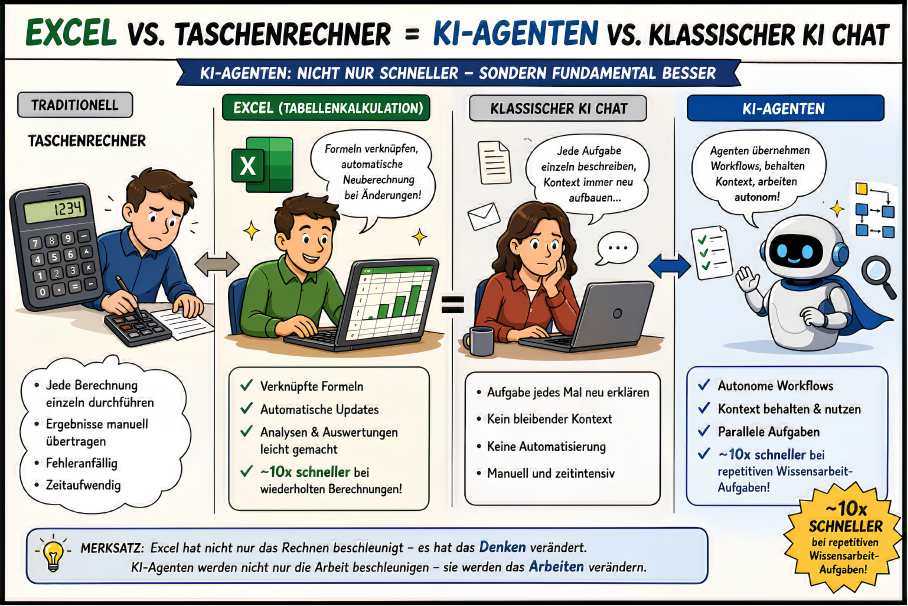
Agents are already embedded in many well-known applications today, such as NotebookLM or Perplexity Deep Research. These systems conduct multi-step searches, utilize external tools such as web search or document analysis, and use this information to independently generate structured results. The agent is therefore often already integrated into the tool itself, rather than being a separate system.
For university staff and faculty, the use of such systems is increasingly becoming a standard part of digital workflows—much like search engines, office applications, or chatbots are today. Potential applications range from off-the-shelf agents—such as intelligent service processes—to personalized learning support or research assistance, all the way to individual generative use.
As part of the GenAI∂KIT project, we are addressing these developments, actively shaping their implementation at the organizational level, and training staff for their general use at the individual level. The discussion paper “Agent-Based AI in the Higher Education System,” developed by the Higher Education Forum on Digitalization and to which Andreas Sexauer contributed on behalf of the project, provides a good overview of application scenarios, opportunities, and challenges.
Personal Use of Agent-Based AI
Staff members can use agent-based AI as a tool for their own work—similar to a digital assistant that performs tasks within a clearly defined framework.
With API access via the AI Toolbox and the ability to use local models, KIT offers excellent conditions for the privacy-conscious and controlled use of such systems. A simple and manageable way to get started is to use VSCodium and Cline. This combination allows you to experiment with agent-based workflows in a local environment. The agent can plan tasks, analyze files, structure content, or suggest changes. At the same time, it remains easy to track what the agent is doing, what it has access to, and which steps are to be executed.
Maintain control instead of taking on unknown risks
This is especially important when getting started: The target is not to immediately hand over tasks entirely to an agent. Rather, it’s about learning step by step how to assign tasks to agents effectively, review their suggestions, and maintain control over your own scope of action. So start with small, manageable tasks and maintain control over each individual step.

⚠️ The more an AI system can do on its own, the more important it is to set clear boundaries. When using AI agents, the following points in particular should be kept in mind:
- Human-in-the-loop: Critical actions should be confirmed by humans.
- Principle of Least Privilege: Agents should only be granted the access rights they truly need.
- Data protection and information security: Sensitive data may only be processed in appropriate, approved environments. Use local models.
In short: Agent-based AI is not an autopilot. It is a powerful tool that requires well-defined task specifications, clear rules, human oversight, and targeted deployment.
Networking and Community
 If you’re already working with agent-based AI or plan to, you’ll find plenty of opportunities for exchange at KIT. Join the AI community on MS Teams or visit the AI Lab to meet like-minded people. There, you can experiment together, exchange ideas informally, discuss your concepts, and collaborate on developing your own AI applications. Just stop by and become part of the network!